 Faithful Living
Written by FaithfulPost Team · Published May 16, 2026
There is something profoundly sacred about the spaces we inhabit. Our homes are far more than mere structures of wood, drywall, and glass; they are the silent witnesses to our lives. They hold our daily routines, our most guarded memories, our quietest moments of weeping, and the joyful rhythms that shape our days. They are the physical backdrop of our spiritual lives.
Yet, when we hear the phrase “Christian home decor,” a specific, often uninspiring image immediately comes to mind. It is easy to picture loud, overly themed rooms cluttered with mass-produced wooden crosses, plastic fish symbols, and cheesy, brightly colored signs shouting verses in unreadable cursive. But faith is not defined by a specific, kitschy aesthetic. A spiritually rich, deeply faith-filled home does not require a frantic shopping trip to a religious bookstore, nor does it require you to turn your living room into a spiritual billboard.
In fact, the most meaningful, spiritually formative homes are often remarkably simple, warm, and thoughtfully curated. They are places where Scripture meets everyday life in subtle, beautiful, and integrated ways. They are environments where the physical space gently exhales peace into the souls of those who walk through the door.
This comprehensive guide will help you create a home that reflects your faith with deep intention, aesthetic beauty, and authentic grace—without needing a professional designer’s budget, a massive square footage, or a perfectly spotless house.
The Theology of Space: Why Your Physical Environment Matters
To understand how to decorate a Christian home, we must first understand the theology of physical space. We are not merely disembodied spirits floating through a physical world; we are embodied souls. God created the physical universe, looked at it, and declared it “very good.” Furthermore, in the Incarnation, Jesus Christ took on physical flesh, permanently validating the material world as a vehicle for divine grace. Because God cares about the physical realm, we must care about it too.
We are deeply, inescapably affected by our physical surroundings. Environmental psychology and biblical wisdom both agree on this point: the space you inhabit shapes your habits, dictates your mood, and directs your spiritual focus.
A cluttered, chaotic, or purely utilitarian home can subtly add to the noise, cortisol, and anxiety of modern life. It preaches a gospel of rush and disorganization. But a home intentionally designed for peace acts as a physical anchor for your soul.
Christian home decor is not about creating a pristine showroom to impress your guests or prove your spiritual superiority. It is about cultivating an atmosphere. It is about arranging your physical space so that when you turn the key and walk through the front door, the environment itself whispers a profound truth: “You are safe here. God is here. You can rest.”
The Golden Rule: Intention Over Accumulation
Before you buy a single piece of art, paint a wall, or move a piece of furniture, you must embrace this foundational principle: Meaningful decor is about curation, not accumulation.
A home filled with dozens of religious signs, crosses on every surface, and verses on every wall can actually create visual noise. It makes the space feel cluttered and reduces the profound weight of Scripture to mere background wallpaper. When everything is emphasized, nothing is emphasized. It can also make the faith feel performative, as if the home is trying too hard to convince its inhabitants (and visitors) of its spirituality.
Instead of filling every available wall and shelf, choose a few highly meaningful, beautifully crafted items and give them ample space to breathe. Let your decor tell a quiet, confident, and cohesive story. In the art world, “negative space” is just as important as the subject itself; it gives the eye a place to rest. The same is true for your home. Less visual clutter creates vastly more mental and spiritual margin, allowing the truth of God’s Word to actually penetrate your heart rather than just bounce off your walls.
Room-by-Room: The Liturgy of the Home
You do not need to overhaul your entire house in a single weekend. Start by looking at the specific rooms in your home and asking a formative question: “How can this space invite my family to pause, reflect, and connect with God?”
The Entryway: Setting the Spiritual Threshold
The entryway is the vital transition zone between the chaos, demands, and spiritual warfare of the outside world, and the sanctuary of your home. Create a simple, intentional “landing zone” that physically and spiritually shifts your posture. Place a small, beautifully framed verse at eye level near the door (Psalm 121:8, “The Lord will watch over your coming and going,” is perfect here). Keep a beautiful bowl for keys, and perhaps place a small mat that serves as a subtle, physical reminder to leave the stress, anger, and anxiety of the day on the welcome mat.
The Kitchen and Dining Room: The Altar of the Everyday
The kitchen is the undeniable heartbeat of the home. It is where sustenance is prepared and life is sustained. Create visual cues for gratitude and divine provision. Use a small, elegant chalkboard or a beautifully framed print on the counter that changes weekly with a verse about gratitude or God’s provision. Keep a beautiful, intentional space for your dining table. A simple centerpiece of natural elements—like a wooden bowl of lemons or a vase of fresh branches—reminds you that this table is not just for eating; it is a place for gathering, blessing, and communion. Pair this with daily Christian rhythms to make mealtimes a spiritual practice.
The Living Room: A Space for Connection and Rest
This is where your family decompresses and connects. However, in modern homes, the living room is often entirely oriented around the television. Intentionally arrange your seating to face each other, fostering conversation and eye contact, rather than just facing a screen. Place a woven basket of beautifully bound books, including a few devotionals, theology books, or Christian classics, on the coffee table to invite intellectual and spiritual engagement. Hang a large, calming piece of art—perhaps a sweeping landscape or a textured abstract piece that evokes God’s majesty—above the main seating area to draw the eye upward. Our guide to using Scripture art offers more on choosing the right pieces.
The Bedroom: A Sanctuary for Surrender
Your bedroom should be the last place you see at night and the first place you see in the morning. It must be a sanctuary for surrender. Keep the color palette soft, muted, and calming. Ruthlessly remove work-related items, laptops, and excessive electronics. The bedroom is for rest and intimacy, not for answering emails. On your nightstand, place a simple, warm lamp, a physical Bible, and a small journal. Let the visual simplicity and quietness of the room invite your racing mind to surrender to God before you close your eyes. Building a daily quiet time rhythm starts with a space that invites rest.
The Bathroom: A Mirror for Identity
The bathroom is where we confront our physical selves in the mirror daily. It is also where the enemy often whispers lies about our appearance, our aging, and our worth. Use this mirror to speak truth over your identity. Apply a simple, elegant, minimalist decal to the corner of the mirror, or place a small, tastefully designed card on the ledge that reminds you of who you are in Christ (e.g., Psalm 139:14, “Fearfully and wonderfully made”). Let the first thing you read in the morning be the truth of your Creator, not the lies of the culture.
Incorporating Scripture with Aesthetic Grace
Many people hesitate to put Scripture on their walls because they worry it will look outdated, cheesy, or clash with their home’s design style. The key is to treat the Word of God with the exact same aesthetic respect and care you would give to any other meaningful, high-quality art.
Typography Matters: Choose clean, modern, classic, or highly readable fonts. Avoid overly stylized, swirling, complex scripts that are impossible to read from a distance. The text should be accessible and clear.
Frame It Well: A beautiful, high-quality frame elevates the text. A simple black, white, or natural wood frame with proper matting makes the Scripture look like intentional, gallery-worthy art rather than an afterthought.
Use Subtle Integration: You do not always need to display an entire, lengthy verse. Sometimes, a single, powerful word (like Grace, Abide, Shalom, Selah, or Hope) in beautiful, minimalist typography is enough to set the spiritual tone of an entire room.
Mix Your Mediums: Scripture does not just have to be printed on paper. It can be elegantly embroidered on a linen throw pillow, laser-carved into a wooden cutting board, woven into a textile, or subtly painted on a ceramic mug. Mixing mediums keeps the space feeling rich and layered.
Bringing the Outside In: The Sacrament of Creation
You do not always need explicitly “Christian” items to create a deeply faith-centered home. Sometimes, the most profoundly spiritual decor is simply God’s creation brought indoors. Psalm 19 declares that the heavens declare the glory of God; bringing elements of creation into your home allows that declaration to continue inside your walls.
Houseplants: Living greenery brings life, vibrant color, and a profound sense of peace into a room. It is a daily, visual reminder of growth, resilience, and the breath of God.
Natural Textures: Incorporate raw wood, natural stone, linen, clay, and woven baskets. These tactile elements ground the space and remind us of the earth God formed from the dust.
Natural Light: Open the curtains. Let the sunlight in. Light is a powerful biblical metaphor for God’s presence, truth, and guidance. A well-lit, sun-drenched room naturally feels more hopeful, inviting, and spiritually alive.
Seasonal Elements: Bring in a bowl of pinecones in the winter, fresh blooming branches in the spring, or warm-toned autumn leaves. Let the changing seasons remind you of God’s faithful, unchanging rhythms in a shifting world. Our seasonal Christian living guide explores this further.
Ebenezer Stones: Curating a Memory Wall of Faithfulness
One of the most powerful, deeply biblical ways to decorate your home is to tell the story of what God has done in your specific, unique life.
In 1 Samuel 7:12, the prophet Samuel took a stone and set it up between Mizpah and Shen. He named it Ebenezer, saying, “Thus far the Lord has helped us.” The Israelites understood the psychological and spiritual necessity of physical memorials. They knew that human beings are prone to forget God’s past faithfulness when facing present trials.
Your home can be a gallery of your own Ebenezer stones. Hang a curated gallery wall of photos that capture significant spiritual and familial milestones—a baptism, a mission trip, a family gathered in prayer, a moment of profound joy.
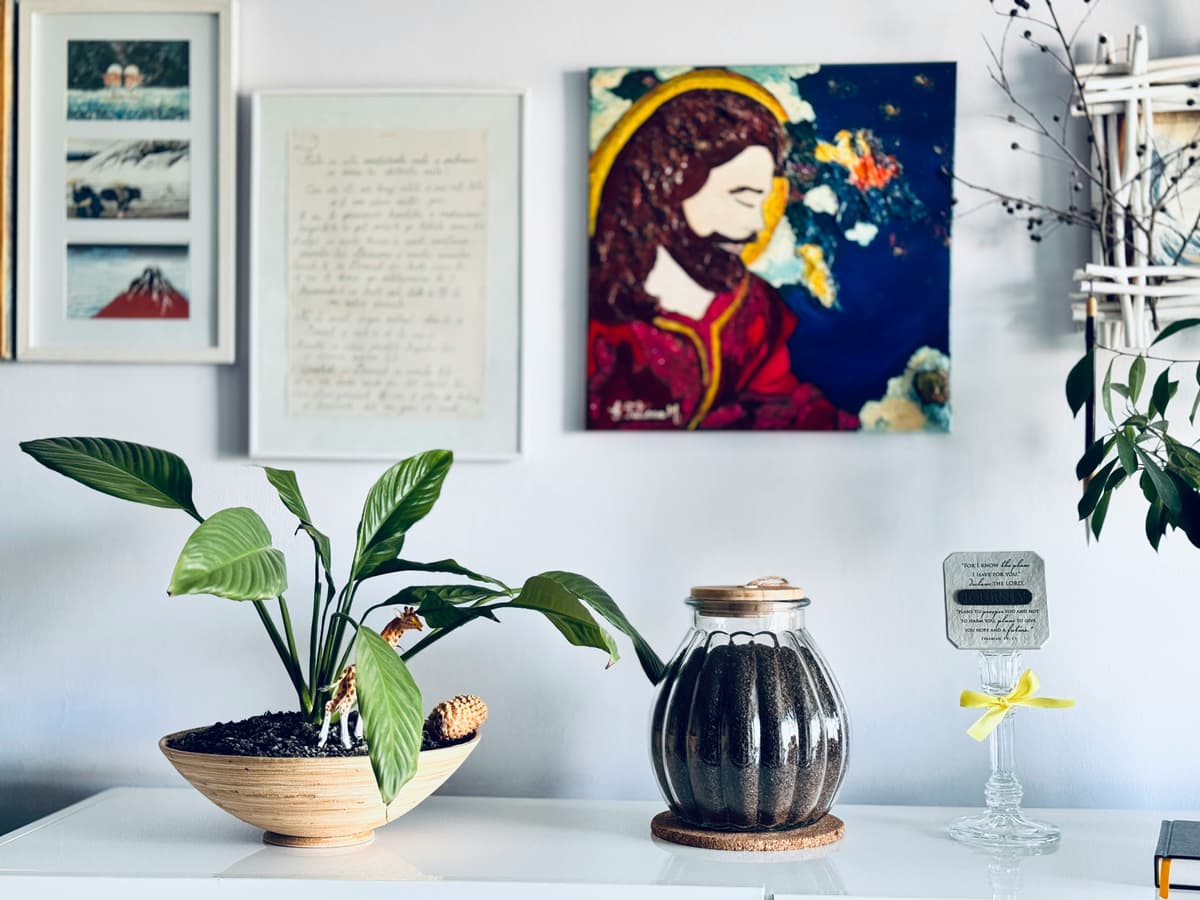
Additionally, keep a beautiful glass jar in a common area as a “prayer jar” or “gratitude jar.” Throughout the year, write down answered prayers, moments of unexpected joy, or verses that sustained you on slips of paper. Read through them together as a family on New Year’s Eve. When you decorate your home with the evidence of God’s faithfulness, you are preaching the gospel to your own heart every time you walk down the hallway. This practice connects beautifully with family discipleship by making God’s faithfulness visible to your children. For a monthly touchpoint of faith delivered to your door, explore the Christian Mail Club.
The Unseen Liturgy: Lighting, Scent, and Atmosphere
We often focus only on what we can see, but a truly faith-filled home engages all the senses. The unseen elements of your home play a massive role in shaping its spiritual atmosphere.
Harsh, overhead fluorescent lighting can make a home feel like a sterile clinic or an interrogation room, spiking anxiety. Instead, rely on warm, layered lighting. Use table lamps, floor lamps, and dimmer switches to create pools of soft, inviting, golden light. This naturally encourages a slower, more reflective, and intimate pace of life.
Scent is also deeply tied to memory, emotion, and the nervous system. Use subtle, natural fragrances to create a calming environment. A lightly scented candle (like cedar, lavender, frankincense, or vanilla) or a simple reed diffuser can make a space feel intentionally cared for and deeply peaceful. Furthermore, lighting a candle can serve as a powerful physical cue—a liturgical action—that signals to your brain and your spirit that it is time to pray, read Scripture, or simply be still.
The Grace Clause: The Idol of the Spotless Home
Here is the most important, liberating thing to remember when trying to create a faith-filled home: You have real, messy, beautiful life happening inside these walls.
There will be toys scattered on the floor. There will be dishes piled in the sink. There will be days when the laundry is piled on the couch, the dog has tracked mud on the rug, and the house smells like burnt toast.
Let me be unequivocally clear: A messy house does not mean you have a messy faith. A home filled with the loud noise of children, the evidence of a shared meal, or the clutter of a busy, active life is not a failure of Christian decor. It is a beautiful, glorious testament to a life being fully lived and deeply loved.
Do not let the pursuit of a “peaceful aesthetic” or the trap of Instagram perfectionism rob you of the joy of a lived-in home. Jesus reserved His harshest words for the Pharisees, who were obsessed with outward cleanliness and the appearance of righteousness while their hearts were far from God (Matthew 23). God is not looking for a magazine cover; He is looking for a willing, loving family.
Grace covers the clutter. Peace transcends the mess. The Scripture on your wall is not there to condemn you for a messy house; it is there to point you to a perfect, gracious Savior who loves you exactly in the middle of the beautiful chaos.
A Dedication Prayer for Your Home
As you begin to intentionally shape your space, dedicate it to the Lord. Pray this over your home:
“Lord, fill this home with Your shalom. Let every room reflect Your presence and Your grace. May these walls echo with laughter, forgiveness, and truth. May our tables be places of provision, gratitude, and hospitality. May our beds be places of deep rest and absolute trust in Your sovereignty. Let Your Word shape our days, and let this home be a refuge for our souls, a sanctuary for our family, and a beacon of light to all who enter. In the beautiful name of Jesus, Amen.”
A Final Word for the One Creating a Faith-Filled Home
You do not need expensive decor. You do not need a professional designer’s eye. You do not need a perfect, spotless, magazine-ready house. You simply need intention.
A Christian home is built one small, faithful choice at a time. It is built with one beautifully framed verse on the wall, one whispered prayer before a meal, one peaceful corner created for reading, and one meaningful object that tells a story of God’s grace.
As you intentionally shape your physical home to reflect His peace, you will discover a profound mystery: God is simultaneously shaping your heart to reflect His love. The space you create for Him will, in turn, create space within you for Him to work.
Your Next Steps in Christian Home & Faith-Centered Living
If you are ready to keep growing, explore these resources to deepen your faith at home:
Typography, framing, and placement tips for beautiful Scripture art.
Gentle practices for a peaceful, faith-filled home.
Everyday ways to weave faith into family life.
Let your home reflect the rhythms of the church year.
Create a sustainable quiet time in your sacred space.
End-times hope and practical daily faith, together.
Want gentle encouragement delivered to your inbox?
Get 7 Days of EncouragementA free devotional series to strengthen your heart with God's Word.